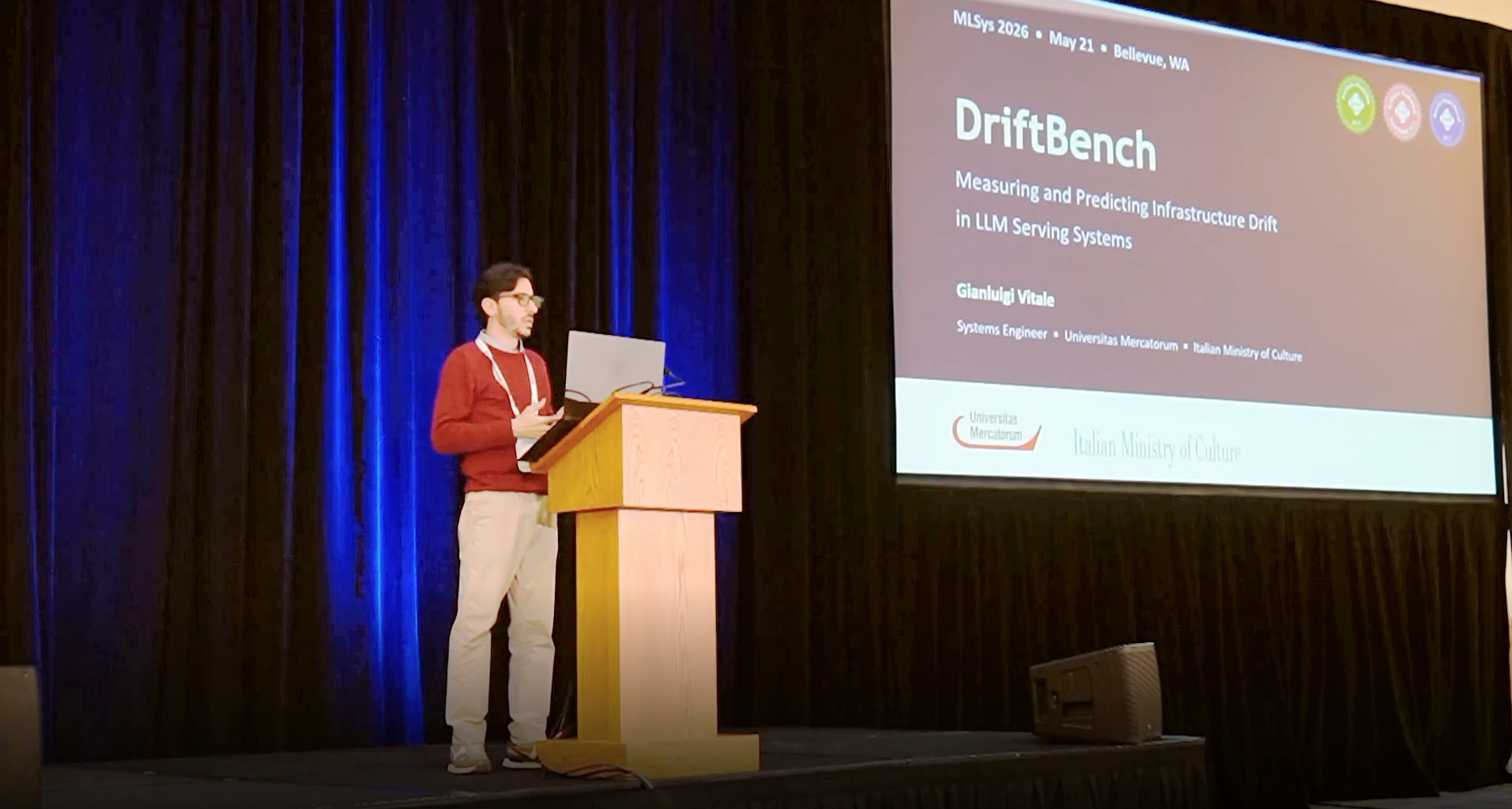
Gianluigi Vitale presenting DriftBench at MLSys 2026 Watch the MLSys 2026 talk

ML systems researcher · Systems engineer

I study how LLM systems fail.

I build and measure the systems beneath model behavior: serving stacks, accelerator kernels, numerical paths, and the failures that appear when infrastructure changes.

Google TPU Research CloudActive since May 2026

Research built with Google TPU Research Cloud

Model bring-up, new kernels, and cross-accelerator validation across TPU v4, v5e, and v6e.

Validated

DriftBench on TPU

Extended the MLSys 2026 result to TPU v5e and v6e. The predictability result held across the new numerical path, with R² from 0.72 to 0.96.

Collaboration

Long-context genomics with ICAR-CNR

A collaboration studying whether long-context DNA models encode linkage disequilibrium, combining ML systems work with genomics expertise at ICAR-CNR (Italy’s National Research Council).

NeurIPS 2026 · Main trackAccepted poster · Sole author

Decomposing One Professional-Framing Pipeline: Which Components Shift LLM Safety Boundaries?

A pre-specified 2×2×2 factorial ablation of the STF professional-framing pipeline: 5,000 human-labeled trials on three closed frontier models in the primary study, four 5,000-trial factorials (20,000 trials) in total, and behavioral checks on six open-weight models. A professional persona was the main driver of acceptance (OR = 6.5), Linguistic Substitution the main driver of response depth (cumulative-logit coefficient β = 0.91), and moral justification showed no detectable positive effect on acceptance.

Under review · MLSys 2027G. Vitale · R. Pietrini

Cross-Generation Numerical Agreement of LLM Inference on TPUs

Probing TPU v4, v5e, and v6e from outside, we localized cross-generation bf16 matrix-multiplication differences to the compiled cross-pass reduction order, and a CPU emulator reproduced 34.6M fresh outputs bit for bit on all three generations (bf16, default precision, four standard input regimes). Matching matrix multiplications alone does not make the model agree: whole-program pinning yields identical logits and greedy text on all three generations, and identical vLLM output on v5e and v6e.

02 / Academic service

Reviewing systems work from evidence to impact.

2026–2027

Program Committee Member — MLSys 2027

Reviewing submissions for the MLSys 2027 technical program.

2026

NeurIPS Ethics Reviewer

Reviewed submissions for ethical concerns, societal harms, research-integrity risks, and compliance with conference guidelines.

2026

Artifact Evaluation Committee Member — SOSP 2026

Distinguished Artifact Evaluator Award

Evaluated research artifacts in memory-efficient model serving and memory-safety analysis for GPU kernels in LLM inference systems. Assessed availability, functionality, reproducibility, and consistency with the associated papers' experimental claims.

2026

Artifact Evaluation Committee Member — MLSys 2026

Evaluated four accepted submissions spanning attention-kernel optimization, ML profiling infrastructure, GPU memory disaggregation, and distributed inference. Reproduced experimental results on rented 8×H100 clusters (RunPod) and AMD MI350X infrastructure (AMD University Program), assessing availability, functionality, and consistency with each paper's claims.

03 / Research agenda

Following failures across the ML systems stack.

My work connects hardware arithmetic, kernels, serving infrastructure, and model behavior. I study where assumptions break and build evidence that makes complex AI systems easier to trust, reproduce, and deploy.

01

Systems and serving

Building and evaluating infrastructure for efficient, reliable model execution across accelerators and deployment settings.

02

Hardware and numerical behavior

Understanding how arithmetic, precision, and kernels shape correctness, performance, and reproducibility.

03

Reliability and safety

Measuring when system or context changes alter model outputs and surfacing risk before deployment.

04

ML systems across domains

Applying systems and long-context methods to domains including genomics and public-sector information access.

PyTorchvLLMSGLangTensorRT-LLMCUDACloud TPUDockerHugging Face

04 / Profile

Research grounded in deployed systems.

Experience2024–present

Systems Engineer — Archivio di Stato di Pistoia (Italian State Archive), Italian Ministry of Culture

Designed and deployed a retrieval-augmented generation system over 10,000 internal administrative documents, delivering source-cited answers to staff queries. Built an AI-assisted public consultation interface giving staff and citizens natural-language access to the full inventory database.

EducationExpected Mar. 2027

B.Sc. in Computer Engineering · Universitas Mercatorum

GPA 29.35/30. Thesis: Natural Language Is Flatland for Machine Intelligence: AI Systems Should Decouple Their Reasoning Substrate from Human Language.

Award2026

Third Prize — International Mathematics Competition for University Students (IMC 2026)

Tied for 171st of 448 (top 40%); most competitors are sent by their universities, about 180 universities in 50 countries. Results ↗ · IMC website ↗

Research conversations & PhD opportunities

Let’s talk about reliable ML systems.

gianluigi.vitale12@gmail.com